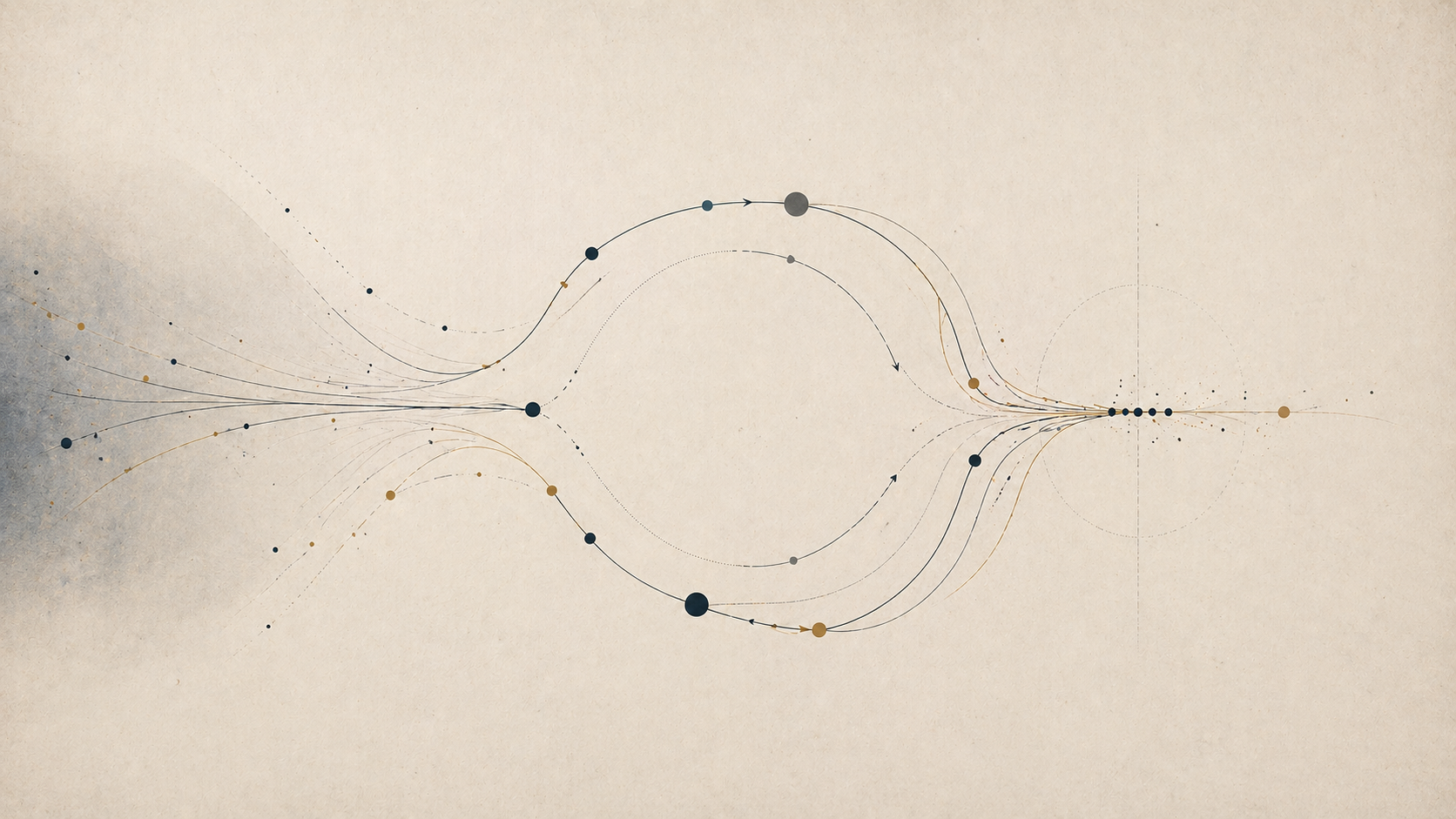
The system that makes you successful may one day become the very system that breaks you.
At first glance, this may look like a paradox. But when you look closer, it is the natural result of poorly designed feedback loops.
Companies promote their best employees into management — and the team gets weaker.
Large-scale artificial intelligence systems make predictions — and can turn into systematic bias machines.
Products scale — and become cages that are increasingly difficult to change.
These are not separate sector-specific problems. They are all the result of the same architectural blindness. What we are facing is neither individual incompetence nor merely a technical failure. The deeper problem is what we call performative prediction: systems do not merely predict the world; they begin to actively construct the very world they predict.
The truth is this: systems do not just understand the world. They change it. Then they become trapped inside the world they created.
Not Linear, but Cyclical Collapse
Most people think of systems as if they were open-loop structures in engineering — a linear flow:
Input → Process → Output
But algorithmic structures and social organizations are closed-loop systems. What actually happens is this:
Output → becomes input again → changes the future
This is where the critical break happens. The system enters a phase we can call performative prediction. It no longer optimizes according to reality, but according to its own behavior. It begins to actively construct the world it predicted.
The Peter Principle Is Not a People Problem
The classic explanation is:
“People are promoted until they reach their level of incompetence.”
This is an incomplete reading.
The real problem is not the person. The real problem is the design that sacrifices organizational health in order to preserve the incentive system.
A study by Benson, Li, and Shue, conducted across 131 companies and 39,000 sales employees, strongly shows that this loop is not merely intuitive but measurable:
When an employee’s sales performance doubles, their added value as a manager decreases by 6.1%.
Promoting a star salesperson to manager costs the team the equivalent of one-third of an average employee’s total output.
A good salesperson does not necessarily make a good manager. The company, in an attempt to preserve short-term carrot-on-a-stick motivation, codes long-term collapse with its own hands. This is not a human error. It is a poorly designed feedback loop.
The Bias Factory: Proxy vs. Reality
The same dynamic exists in algorithmic systems. Machine learning models are not fed by static datasets, but by dynamic worlds that are continuously reshaped by the consequences of their own decisions. When the measured value — the proxy — drifts away from the intended reality — the ground truth — the system collapses.
The core loops that blind systems are:
Sampling Loop: The system fails to understand a speaker with an accent. That user leaves the system. Because this group disappears from the dataset, the system confirms its own limitation by saying, “This user group does not exist anyway.”
Individual Loop: The algorithm polarizes the user. As the user becomes more radicalized, they consume more extreme content. The system treats this new radicalism as “natural behavior” and widens the gap. This creates a spiral that feeds historical bias.
Feature Loop: In the credit score example, when the system refuses credit to someone it considers “risky,” it limits that person’s financial mobility and causes their score to deteriorate further. Observable features — proxies — are artificially manipulated by the system’s own intervention.
ML Model Loop: HR algorithms that learn only from the data of candidates who already match existing success criteria become blind to the broader talent pool outside that pattern.
Outcome Loop: The system’s prediction creates the outcome itself. Higher interest rates can mathematically increase the risk of default. When the system says, “I told you so,” it may actually have created the failure with its own hands.
What looks like accuracy is often a massive act of self-confirmation.
Strategic Games: Human Behavior Changes When the System Starts Measuring
One of the most critical effects of feedback loops is that people begin to behave strategically against the system.
When a system turns a metric into a decision mechanism, people no longer behave naturally. They start trying to understand what the system rewards — and position themselves accordingly.
Someone who wants to get credit may try to make their credit score “look good” instead of improving their actual financial health. A student preparing for university may focus not on truly learning, but on beating the exam format. A content creator may stop focusing on strong ideas and start imitating behaviors that the algorithm rewards.
At this point, what the system is trying to measure becomes corrupted.
Because the data is no longer a clean reflection of real behavior. It becomes an output shaped to adapt to the system.
When a metric becomes a target, it stops measuring reality and becomes the rule of the game.
This is why what we call an adversarial feedback loop is not merely a security problem. It is also a structural risk that weakens the system’s connection to reality.
The system thinks it is measuring truth, but it is actually collecting behaviors produced by people trying to beat the system. And when it makes new decisions based on that data, it further damages its own measurement ground.
Escaping the Cage: Critical Systems Thinking
Systems do not collapse because they are weak. They collapse because they work too well locally.
We cannot escape these loops simply by writing more code or forcing isolated metrics harder. Critical Systems Thinking treats these structures not merely as technical mechanisms, but as complex entanglements of technical, political, and human factors.
This is exactly where Dr. W. Edwards Deming’s System of Profound Knowledge becomes relevant. One of the core warnings of his approach is that optimizing parts of a system separately, without understanding the system as a whole, can weaken the whole instead of strengthening it.
You can optimize sales. You can optimize the ML model. You can optimize the team. But if you fail to see the whole, the system begins to collapse. Because local success creates global failure. Leaders and architects must stop acting merely as inspectors and become strategists who control invisible loops.
More data, inside the wrong loop, only makes the wrong answer look more confident. The way out is to regularly question what the system reinforces, what it makes invisible, and which behaviors it rewards.
Final Thought
Short-term stability is often the quiet warning sign of long-term chaos.
You are not merely building an organization, a product, or an architecture. You are building a loop. What you reinforce grows, stabilizes, and eventually traps you inside it.
So the real question you need to ask is this:
Will the system I am building remain connected to reality, or will it become a perfect cage that traps my future performance?