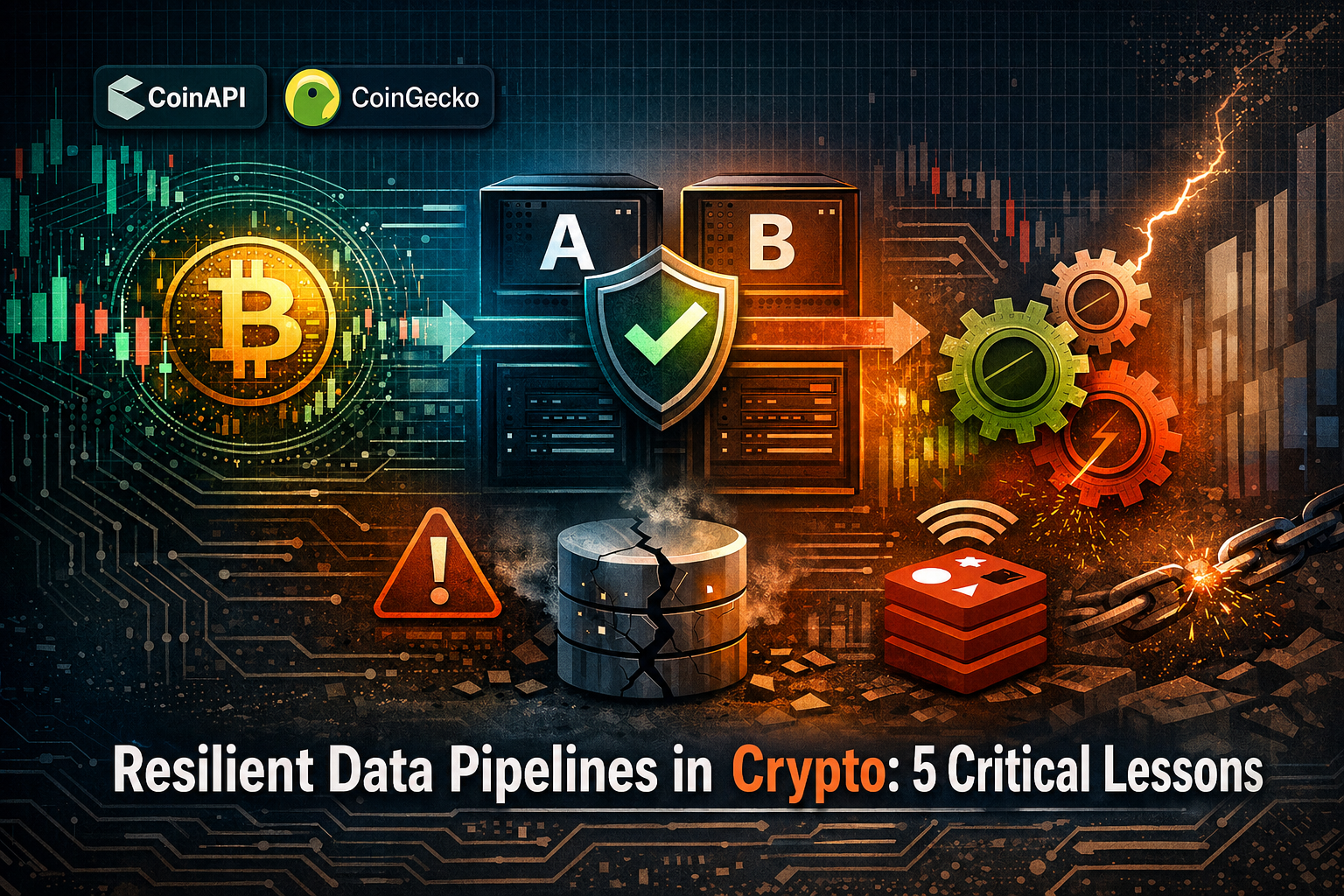
1. Introduction: Seeking Consistency in the Midst of Chaos
Unlike traditional financial markets, the cryptocurrency market is characterized by volatility measured in seconds, operates 24/7, and has virtually zero tolerance for error. In this chaotic sea of data, the symbol catalog that represents the “truth” for a financial platform is a cornerstone of the system. An incorrect trading pair or an incomplete listing is not merely a technical issue—it can result in financial loss.
The architecture of the service that manages symbol data (SymbolService) within the HemenBasvur platform faces a fundamental engineering paradox while collecting thousands of records from major providers such as CoinGecko and CoinAPI:
How can we guarantee data consistency in distributed systems without causing service interruptions?
This article examines five key lessons from the architecture of a service that can remain “correct” even when it fails, viewed from the perspective of a modern system architect.
2. A/B Collection Swapping: The Invisible Art of “Zero Downtime”
Writing directly over live data in high-traffic systems creates risks such as dirty reads and partial data corruption. SymbolService mitigates these risks through an A/B collection-swapping strategy in MongoDB combined with atomic state transitions.
The architecture writes new data not to the currently active collection, but to a passive "next" collection. The crucial step takes place after the write operation is completed. With a single atomic FindOneAndUpdate operation on the metadata record that stores the active collection information (SymbolsSnapshotMeta), the field that identifies the active collection (ActiveSuffix) is switched between A and B, while the dataset version number (SnapshotVersion) is monotonically incremented.
There is no window in which an incremented version can be read while still pointing to the old collection.
From a senior engineering perspective, there is still a residual risk to consider: clearing the current passive collection (ClearAsync) and bulk-inserting the new records (AddRangeAsync) are not performed within a transaction. If the process crashes immediately before the metadata update that switches the active collection, the passive collection may remain empty.
For this reason, a resilient architecture does not rely solely on application logic. It also uses safety barriers such as a startup health check to verify that the active collection is not empty.
3. The Power of Doing Nothing: Empty Snapshot Guard
Software systems often have an instinct to always remain up to date. However, sometimes doing nothing is the smartest way to prevent a major failure.
The empty-snapshot guard in the SymbolService architecture is a critical checkpoint that prioritizes data integrity over freshness.
If the process of combining data from external providers produces zero valid entities, the system immediately stops the update flow. This situation may not be caused only by provider downtime. A change in an API format or an error in the filtering logic—for example, the failure to find expected trading pairs such as SPOT/USDT—could accidentally cause the entire catalog to be deleted.
This counterintuitive strategy is based on a simple principle:
It is better to continue with stale but consistent data than to publish an empty list and bring the entire platform to a halt.
As an architectural invariant, this protection acts as a safety valve that prevents the system from destroying its own data.
4. Dual-Event Strategy: Standing Strong Even When Redis Fails
Modern systems rely heavily on caching layers such as Redis. However, these components should not become single points of failure.
SymbolService checks whether the Redis write operation has succeeded and uses a dual-event strategy through the MassTransit messaging infrastructure:
Normal path (
SymbolsUpdatedEventV1)
When the data is successfully written to Redis, the normal update event is published. This event carries only a reference to the data’s location or version and instructs consuming services to read the data from Redis.Fallback path (
SymbolsSnapshotEventV1)
If the Redis connection is unavailable or the write operation fails, a fallback update event is published. This event carries the complete dataset in its payload.
The flexibility of this architecture comes from the fact that downstream services treat both event types as functionally equivalent. When Redis fails, performance may degrade and latency may increase, but the data flow can continue.
This is a practical example of graceful degradation in distributed systems.
5. Confronting Technical Debt: The Hidden Danger of Hardcoded Secrets
Even the best-designed architectures can fail when operational security is neglected. The hardcoded API key found in the component that manages the CoinAPI connection (CoinApiClient) is one of the most serious forms of technical debt.
Architectural excellence is not only about algorithmic efficiency; it is also about operational agility. A key embedded in the infrastructure layer creates several risks:
It may leak into the source code repository.
Rotating the key may require the application to be recompiled and redeployed.
A CoinAPI API key is hardcoded in the infrastructure layer and cannot be rotated without changing and redeploying the code.
To protect the system architecture, security requirements must be treated as a priority. API keys, connection strings, and other secrets should be managed dynamically through IConfiguration, environment variables, or a dedicated secrets-management system.
A system’s resilience is directly related to how easily it can be operated, updated, and maintained.
6. Conclusion: Building the Financial Infrastructure of Tomorrow
The SymbolService example demonstrates that a resilient system is not merely a collection of code that works under ideal conditions.
True architectural strength lies in:
Atomic state transitions through A/B collection swapping,
Data-integrity protection through empty-snapshot controls,
Infrastructure independence through Redis fallback mechanisms,
Operational security through disciplined configuration management.
When designing a system, ask yourself:
Does my system work only when everything is operating normally, or is it robust enough to preserve the truth even when external APIs go offline and database connections become unstable?
In the financial systems of tomorrow, only architectures designed in advance to remain operational during chaotic conditions—through principles such as Chaos Engineering—will endure.